青砖黛瓦藏忠骨,雕梁画栋记烽烟。
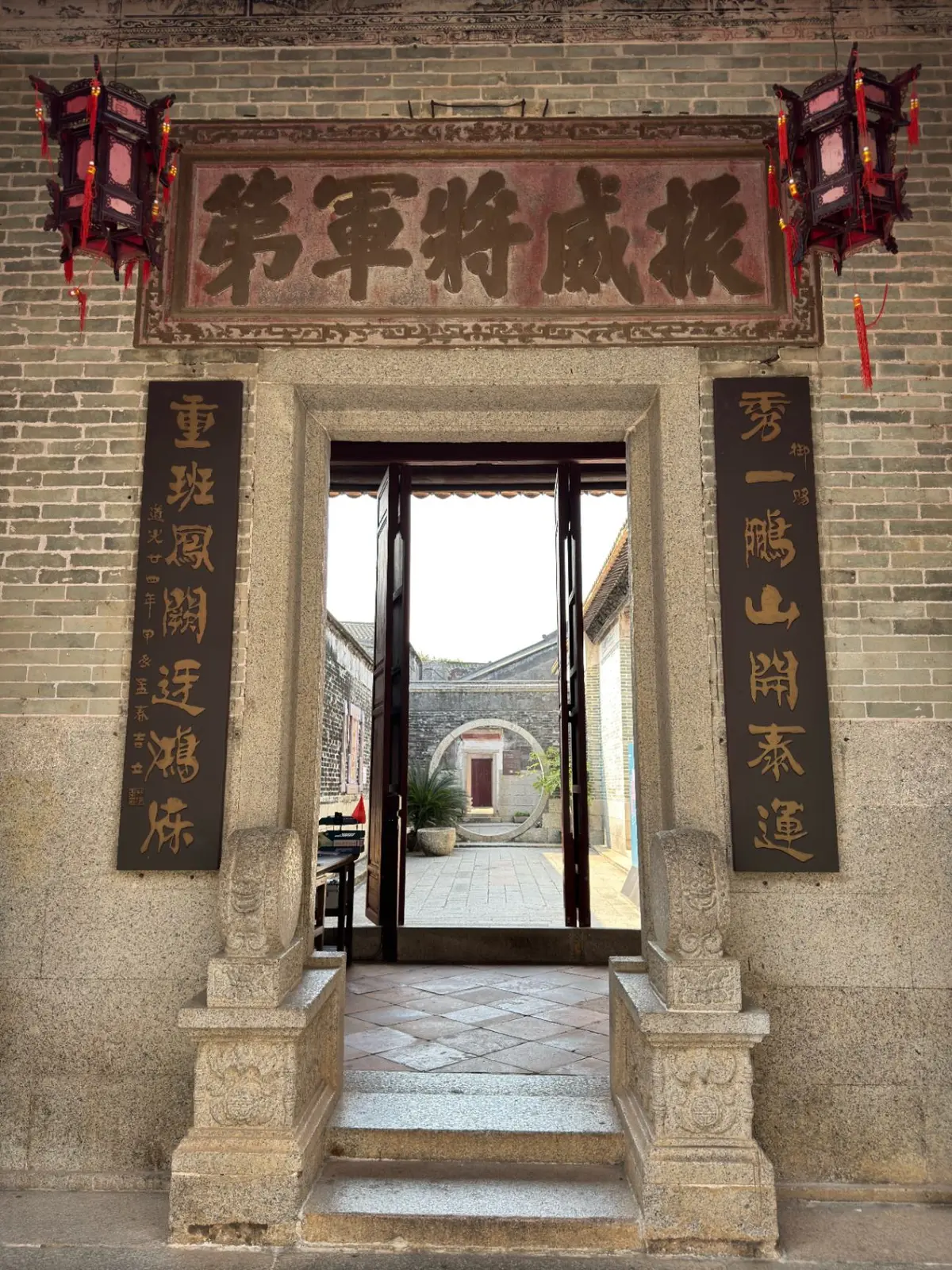
在深圳大鹏半岛的山海之间,矗立着一座历经六百余年风雨的海防古城——大鹏所城。沿着南门街青石板路走入城内百余米,一座气势恢宏的清代府第便赫然在目。朱红门柱擎起飞檐,麻石匾额镌刻御笔,石狮石鼓分列两侧,这便是深圳现存规模最大、保存最完好的清代将军府邸——赖恩爵振威将军第。
这座建于道光二十四年(1844年)的古建筑,建筑面积达2500平方米,不仅是岭南府第建筑的典范之作,更见证了中国近代海防史上一段可歌可泣的抗英传奇。
一、建筑风骨:岭南府第的巅峰之作
振威将军第坐落于大鹏所城南门右侧赖府巷,坐北朝南,侧门内进,是典型的清代府第式建筑群。整座府邸以丈许高的青砖墙围合,由东西两列平行建筑组成,中以巷道相隔,形成"左堂右寝"的经典格局,大小房屋四十余间,堂、舍、膳、庭、园、楼一应俱全,功能完备,规制森严。
门庭气象:御笔亲题的荣耀
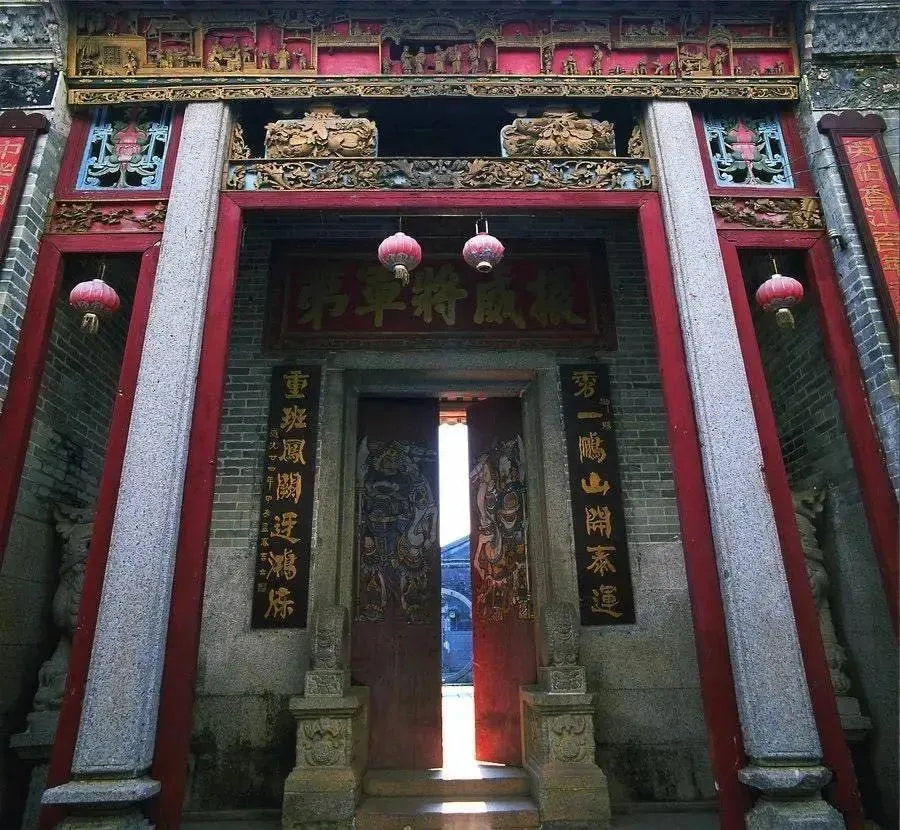
府邸大门设于东南角,朝东而开。门首横额石匾上,"振威将军第"五个楷书大字笔力遒劲,乃清道光皇帝御笔亲书。两侧门联"秀一鹏山开泰运,重班凤阙迓鸿庥",同样出自道光皇帝手笔,取大鹏山川钟灵毓秀、朝堂恩泽绵延之意。门前一对抱鼓石与一对石狮分立左右,石鼓象征武功门第,石狮镇守家宅安宁,是清代一品武官府邸的标准规制。
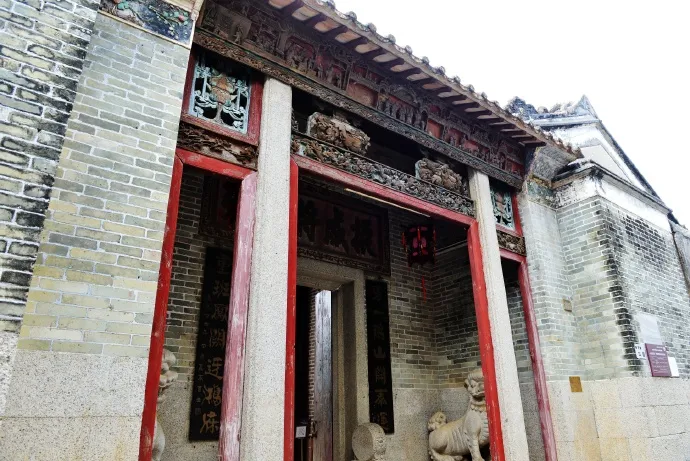
门楼檐板与梁枋之上,布满精美的金木雕刻,人物故事、花鸟草木、墨书诗词错落其间。细看之下,麒麟、狮子、鹿、蜜蜂、猴子、麻雀等瑞兽禽鸟栩栩如生,各有寓意:"雀"谐音"爵",暗合主人赖恩爵之名;"鹿"通"禄",祈愿福禄绵长;蜂与猴则取"封侯"之吉兆。方寸木雕之间,既是艺术匠心,亦是门第期许。
院落格局:三套三进的礼制空间
将军第采用"三套三进三间"的复杂布局。当心间为三厅二天井,左右次间各三厅二天井、十厅房;侧间为三进三间,三厅、三天井、十二厢房。两间前长廊以圆形月门相通,地面铺砌大阶砖,墙基以麻石砌筑,其上青砖到顶。长廊前设倒厢,正侧间有前院、侧廊,侧间有后院及偏厢,前后院各凿水井一口,形成完整的给排水与生活系统。
建筑主体为砖木结构,青砖墙、红砖地、木梁架、石柱础,屋顶为硬山顶式,中设灰脊,稳重而大气。室内地面明间作菱格铺设,其余作"工"字铺法,细节之处尽显章法。漫步其间,天井采光通透,廊道迂回曲折,厅堂轩敞肃穆,厢房静谧幽深,一进一重天,一步一换景,是岭南客家建筑与官府规制的完美融合。
怡文楼:将军的书香天地
在振威将军第旁,还坐落着一座建于道光二十六年(1846年)的怡文楼,面积360平方米,为砖木结构二层建筑,两进三开间,中设天井。这里曾是赖恩爵的书房,内挂"崇兰书室"牌匾,后期亦作为赖氏家族子弟读书的家塾。武略之外亦重文修,恰是赖氏家族"欲知官以尚,时怀读我书"家训的真实写照。
二、将门传奇:三代五将的忠勇世家
一座将军第,半部海防史。振威将军第的主人赖恩爵,是中国近代史上声名赫赫的抗英名将,而他背后的赖氏家族,更是创造了"三代五将"的将门奇迹,民间素有"宋有杨家将,清有赖家帮"之誉。
赖氏崛起:从布衣到将门
赖氏先祖赖吾彪于清雍正年间从广东紫金县义容镇甘棠村迁至大鹏所城,以编竹篾为生,家境贫寒。至第三代赖世超,弃文从武,考取武举人,官至闽粤两省武举考官,封武功将军(正二品),成为赖氏"三代五将"中的第一位将军。
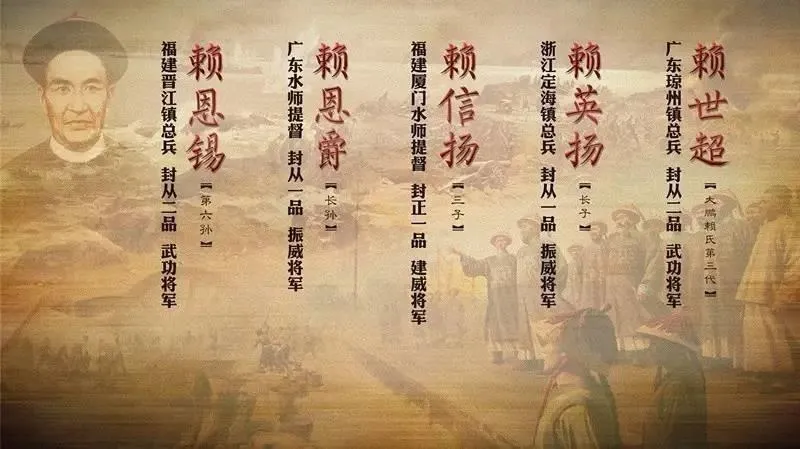
赖世超育有二子:长子赖英扬,官至浙江定海镇总兵官,死后晋封振威将军(从一品);三子赖信扬,官至福建水师提督,封安鹭将军(正一品)。赖英扬之子赖恩爵、赖信扬之子赖恩锡,亦成长为一代名将。祖孙三代,三位一品、两位二品,五位将军同出一门,在中国历史上极为罕见。
赖恩爵:三十六战无一败绩的水师名将
赖恩爵,字简廷,生于清乾隆五十九年(1795年)。他自幼随父赖英扬在军营长大,少年入伍,从兵士做起,历任把总、千总、守备、都司、游击等职,道光十八年(1838年)补海门营参将。他一生历经三十六场大小海战,无一败绩,是晚清水师中难得的常胜将领。
真正让赖恩爵名垂青史的,是1839年的九龙海战。
虎门销烟后,英军不甘鸦片贸易受挫,不断在广东沿海挑衅。道光十九年(1839年)七月,林则徐命大鹏营参将赖恩爵率水师船三艘驻守九龙寨,严断英夷接济。九月初四,英方五艘大型战舰突然向中国水师发动袭击。面对装备悬殊的强敌,赖恩爵临危不乱,指挥水师奋勇还击,激战五个时辰,重创英舰,迫使敌军狼狈逃窜。
这场海战是中国近代史上反侵略战争的第一仗,打响了鸦片战争的第一枪。捷报传至京城,道光皇帝龙颜大悦,御赐赖恩爵"呼尔察图巴图鲁"称号(满语意为勇士),赏戴花翎,晋级副将。此后,赖恩爵又在香港附近海域六战六捷,多次击退英军挑衅。
道光二十三年(1843年)冬,赖恩爵升任广东水师提督,接掌虎门防务,填补了关天培殉国后留下的空缺。然而,清政府的腐败懦弱让这位常胜将军壮志难酬。《南京条约》签订后,香港岛被割让给英国,赖恩爵忧愤交加,虽多次刺探香港英人情报、力图收复,终因国力衰微而回天乏术。道光皇帝曾连下三道圣旨召他进京高升,他三次上表辞谢,不愿与朝中求和派同流合污。
道光二十八年(1848年),赖恩爵含恨病逝于任上,年仅53岁。朝廷追封其为从一品振威将军。临终前,他召集子孙留下遗言:"吾忧朝政腐败而忧,吾乐收回香港而乐!"这句遗言,成为赖氏家族跨越一个半世纪的精神坐标。
三、岁月流转:一座府邸的百年变迁
从道光二十四年敕建至今,振威将军第已走过一百八十余个春秋。这座深宅大院见证了赖氏家族的兴衰荣辱,也镌刻着时代更迭的深深印记。
敕建荣光:御赐府邸的诞生
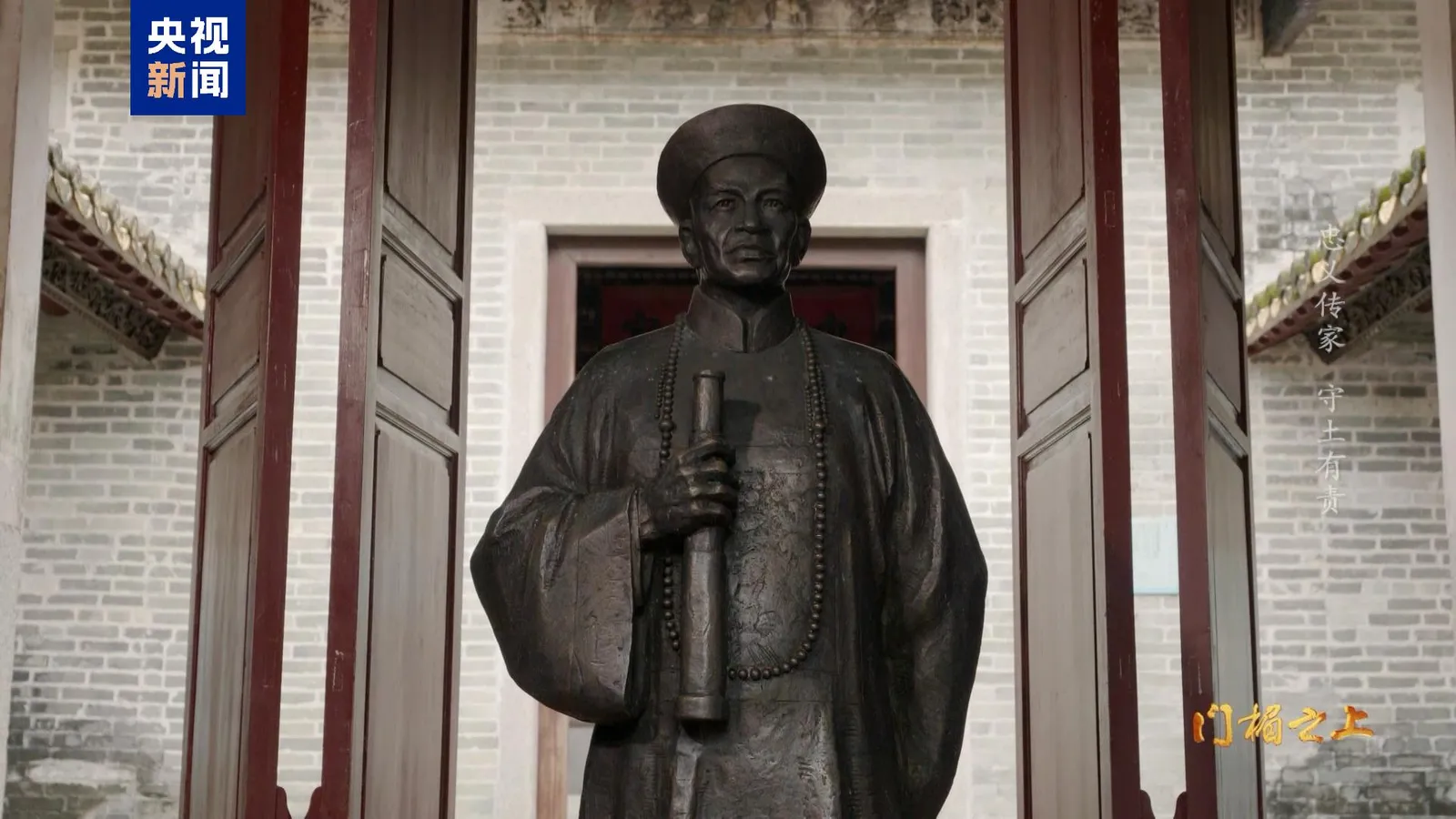
道光二十四年(1844年),为嘉奖赖恩爵九龙海战之功,道光皇帝下旨敕建振威将军第。朝廷遴选能工巧匠精心设计施工,历时两年建成。作为御赐的"诰封第",其建筑规制、用料工艺均代表了当时岭南府第建筑的最高水准。府邸建成之日,地方官员纷至沓来拜谒,赖氏家族声望达到顶峰。
此后近百年间,这里一直是赖氏族人聚居之所。赖恩爵长子赖绍贤亦官至将军,其府第就在附近。赖氏子孙在此繁衍生息,恪守祖训,或从军报国,或耕读传家。咸丰年间,朝廷曾因赖家出官过多而派人暗查,最终证实全凭军功实绩,无半分裙带关系,反而盛赞其"世代忠良"。
乱世沉浮:从将门到寻常
清末民初,时局动荡,大鹏所城的军事功能逐渐弱化,赖氏族人或从军远赴他乡,或出海谋生,府邸渐显寥落。抗日战争时期,日军曾进驻所城,部分建筑遭到破坏。新中国成立后,将军第曾作为集体用房、民居使用,部分厢房被改造,原有陈设散佚,但主体建筑结构得以保存。
改革开放初期,深圳经济特区成立,城市建设如火如荼。1981年,深圳市开展第一次文物普查,振威将军第的历史价值重新被发现。1984年,深圳市人民政府将其公布为第二批重点文物保护单位,开启了系统性保护的序幕。1989年,大鹏所城被列为广东省文物保护单位;2001年,作为大鹏所城的核心组成部分,振威将军第跻身全国重点文物保护单位。
还我祖愿:跨越百年的家国回响
1997年6月21日,距离香港回归还有十天。一百多位赖氏后人从世界各地赶回大鹏所城,齐聚振威将军第,举行隆重的家祭。他们在大门内影壁上悬挂起"还我祖愿"牌匾,以告慰赖恩爵将军在天之灵——一百将军在天之灵——一百四十九年前将军临终的忧乐之叹,终于在这一朝得偿。
这不是一次简单的家族祭祀,而是一段跨越世纪的家国情怀的回响。从九龙海战的炮声,到香港回归的钟声,振威将军第的青砖黛瓦之间,始终萦绕着中国人守土有责的铮铮风骨。2025年,中央广播电视总台《记住乡愁》栏目专题报道了大鹏赖氏"忠义传家、忧乐天下"的故事,让这座百年府邸再次走进全国观众的视野。
四、家风永续:刻在青砖上的精神密码
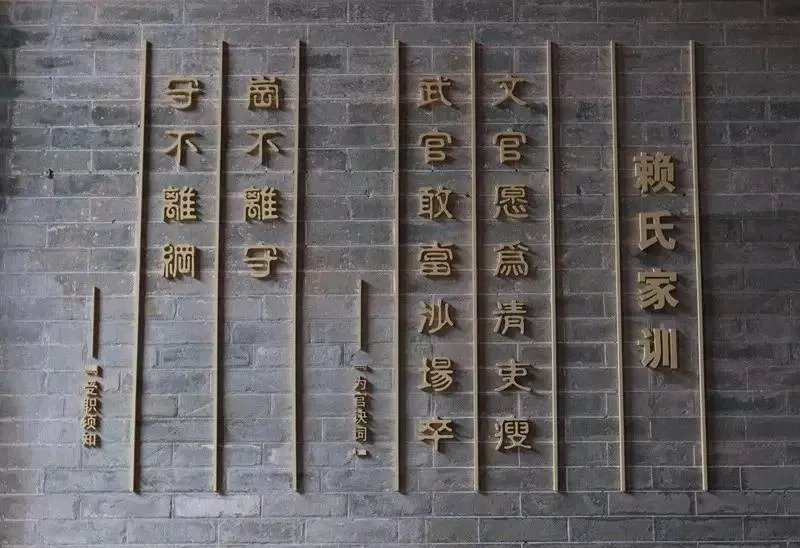
走进今日的振威将军第,厅堂墙壁上,一组赖氏家训格外醒目。"岗不离守,守不离纲""文官愿为清史瘦,武官敢当沙场卒""欲知官以尚,时怀读我书""人生学,学而生,先立品,学圣贤"……这些质朴而铿锵的文字,正是赖氏家族绵延近三百年的精神密码。
岗不离守:刻入骨髓的职业操守
"岗不离守,守不离纲"是赖家家训中最核心的一条。对军人而言,岗就是阵地,纲就是军纪国法。从赖世超做起,赖家子弟从军,从最低级的兵士干起,凭战功逐级晋升,从不倚仗家世。赖恩爵从士兵到水师提督,每一步都走得扎实。即便是身居高位,他始终坚守海防前线,三次拒召进京,正是"岗不离守"的最好诠释。
这种精神代代相传。时至今日,赖氏后人中仍有不少人投身军警、公职岗位,恪守本分,兢兢业业。在他们看来,将军的荣耀不是用来炫耀的资本,而是一份沉甸甸的责任。
忠义传家:跨越时空的精神传承
如今的振威将军第,不仅是一处文物古迹,更是深圳重要的爱国主义教育基地。每年都有大批学生、游客前来参观,聆听九龙海战的故事,感受赖氏将门的爱国情怀。府内陈列着赖恩爵生平事迹展、九龙海战复原图、赖氏家族谱系等展品,让百年历史可触可感。
每年重阳节,海内外赖氏宗亲都会回到这里祭祖。烤金猪、读家训、叙乡情,仪式庄重而温情。对赖氏后人而言,振威将军第不仅是祖先的居所,更是家族的精神原乡。"忠义传家"的匾额高悬中堂,提醒着每一位后人:无论走多远,都不能忘记从哪里出发,为什么出发。
五、今日风华:古城深处的文化坐标
斗转星移,岁月如歌。如今的振威将军第,静静安卧在大鹏所城的青石板街巷深处,与周边的民居、商铺、咖啡馆和谐共生,成为深圳这座年轻城市中最厚重的历史注脚之一。
作为全国重点文物保护单位,振威将军第得到了精心的修缮与保护。文物部门遵循"修旧如旧"原则,对墙体、梁架、木雕、瓦面进行定期维护,让这座一百八十岁的古建筑依然风骨凛然。府内的金木雕刻虽历经岁月侵蚀,仍依稀可见当年的精美华丽,是岭南雕刻艺术的珍贵遗存。
站在振威将军第门前,一边是六百余年的古城墙,一边是日新月异的深圳东海岸;一边是铁马冰河的往事,一边是烟火寻常的当下。朱红大门开合之间,历史与现实在此交汇。这座府邸的价值,早已超越了建筑本身——它是一座城市的文化根脉,是一个民族的精神缩影,是刻在南中国海之滨的一枚深沉的文化印章。
山河无恙,忠魂不泯。振威将军第的故事,还在大鹏湾的海风里,继续讲述着。
资料来源:
大鹏新区文化广电旅游体育局:《赖恩爵振威将军第》,大鹏新区政府在线,2021年3月
深圳博物馆:赖恩爵人物档案,深圳博物馆官网
南方+:《"宋有杨家将,清有赖家帮"——大鹏赖氏三代出五将,爱国家风传承近300年》,2017年6月
央视新闻:《文化中国行·记住乡愁丨忠义传家 守土有责》,2026年2月
深圳新闻网:《中新网:大鹏所城,一座古城承载的600年红色记忆》,2021年6月
中共深圳市委统战部:《大鹏所城,一声炮响开启深港百年风云》,2024年12月
南粤古驿道网:《驿道上的海防重镇——大鹏所城》,2018年1月
《深圳百科全书》:赖恩爵将军第条目,深圳百科,2022年1月
Blue bricks and gray tiles conceal loyal bones; carved beams and painted rafters record the smoke of war.
Amid the mountains and seas of Shenzhen's Dapeng Peninsula stands an ancient coastal-defense city that has weathered six hundred years—Dapeng Fortress. Walking a hundred-odd meters along the flagstone path of South Gate Street into the city, a magnificent Qing-era mansion comes sharply into view. Vermilion pillars prop up flying eaves; a granite plaque bears an imperial inscription; stone lions and drum stones flank the entrance. This is the Zhenwei General's Mansion of Lai Enjue—the largest and best-preserved extant Qing general's residence in Shenzhen.
Built in the 24th year of Daoguang (1844), with a built area of 2,500 square meters, this building is not only a paragon of Lingnan mansion architecture but also a witness to a stirring, tear-jerking anti-British legend in modern Chinese coastal-defense history.
I. Architectural Character: The Pinnacle of Lingnan Mansion Design
The Zhenwei General's Mansion sits on Laifu Lane to the right of Dapeng Fortress's South Gate, facing south with a side entrance—a classic Qing mansion complex. Enclosed by blue-brick walls over a meter high, it comprises two parallel east-west building rows separated by a lane, forming the classic "hall on the left, quarters on the right" layout. With more than forty rooms of various sizes, it is fully equipped with halls, quarters, kitchen, courtyards, garden, and tower, strict in function and regulation.
Gateway Presence: The Glory of an Imperial Inscription
The mansion gate is set at the southeast corner, opening eastward. On the horizontal stone plaque above the gate, the five regular-script characters "Zhenwei Jiangjun Di" (Mansion of General Zhenwei) are vigorous and forceful—written by the Daoguang Emperor himself. The couplet on either side, "Xiu yi Pengshan kai taiyun, Zhong ban Fengque ya hongxiu" (May the fortune of Peng Mountain usher in prosperity; may the grace of the court extend endlessly), is also the emperor's hand, invoking the spiritual elegance of Dapeng's mountains and the enduring favor of the court. A pair of drum stones and a pair of stone lions stand left and right: the drum stones symbolize a martial household, the lions guard the home's peace—standard regalia for a first-rank Qing martial official's residence.
Upon the eave boards and beam brackets are exquisite gold woodcarvings—figure stories, flowers, birds, plants, and ink calligraphy interspersed. Look closely and the auspicious beasts come alive: qilin, lions, deer, bees, monkeys, sparrows—each with meaning. "Que" (sparrow) puns with "jue" (the general's name, Enjue); "lu" (deer) sounds like "lu" (salary/fortune), praying for lasting blessing; bees and monkeys together signal "feng hou" (enfeoffment as a marquis). Within these square inches of carving lies both artistic craft and a family's hopes.
Courtyard Layout: The Ritual Space of Three Sets, Three Courts
The mansion adopts the complex "three sets, three courts, three bays" layout. The central bay holds three halls and two skywells; the left and right side bays each have three halls, two skywells, and ten rooms; the side wings have three courts, three bays, three halls, three skywells, and twelve wing rooms. The two front corridors connect via round moon-gates; the floor is laid with large step-bricks, the wall base with granite up to the blue brick courses above. In front of the corridors are reverse wings; the main and side bays have front courtyards and side galleries; the side wings have back courtyards and offset rooms; front and back courtyards each hold a well, forming a complete water-supply and drainage system.
The main structure is brick-and-wood: blue-brick walls, red-brick floors, wooden beam frames, stone column bases, with a hard-slope roof and a central gray ridge—steady and grand. The central hall floor is laid in a diamond grid, the rest in a "gong"-character pattern; detail everywhere shows method. Strolling through, skywells admit clear light, corridors wind, halls are spacious and solemn, wing rooms quiet and deep—one realm per step, a new scene with every pace—a perfect fusion of Lingnan Hakka architecture and official regulation.
Yiwen Building: The General's Literary Sanctuary
Beside the Zhenwei General's Mansion stands the Yiwen Building, built in the 26th year of Daoguang (1846), 360 square meters, a two-story brick-and-wood structure with two courts and three bays and a central skywell. It was once Lai Enjue's study, hung with a "Chonglan Book Room" plaque, and later became the family school for Lai clan children. Valuing letters alongside martial prowess—this is the true reflection of the Lai family motto: "Would you know the officer's stature, ever hold my book to read."
II. The Legend of a Martial Clan: Three Generations, Five Generals
One general's mansion, half a coastal-defense history. The master of the Zhenwei General's Mansion, Lai Enjue, is a famed anti-British hero of modern Chinese history; behind him, the Lai clan achieved the martial miracle of "three generations, five generals," folk-praised as "the Song had the Yang family generals; the Qing had the Lai clan's aid."
The Rise of the Lai Clan: From Commoner to Martial House
Lai Wubiao, the Lai ancestor, moved from Gantang Village, Yirong Town, Zijin County, Guangdong, to Dapeng Fortress during the Yongzheng reign, making a living weaving bamboo strips, poor in circumstances. By the third generation, Lai Shichao abandoned letters for martial arts, passed the military juren exam, and became the military examiner for both Fujian and Guangdong, honored as Martial Virtue General (second rank)—the first of the Lai "three generations, five generals."
Lai Shichao had two sons: the eldest, Lai Yingyang, rose to Brigade General of Dinghai, Zhejiang, posthumously honored as Zhenwei General (second rank from first); the third, Lai Xinyang, became Commander of the Fujian Navy, honored as Anlu General (first rank). Lai Yingyang's son Lai Enjue and Lai Xinyang's son Lai Enxi also grew into famed generals. Three generations—three first-rank and two second-rank officers, five generals from one house—exceedingly rare in Chinese history.
Lai Enjue: A Naval Commander Undefeated in Thirty-Six Battles
Lai Enjue, styled Jianting, was born in the 59th year of Qianlong (1795). He grew up in the barracks with his father Lai Yingyang, enlisted as a youth, and rose through the ranks—company commander, battalion commander, guard captain, lieutenant colonel, guerrilla officer—becoming Assistant Regional Commander of the Haimen Battalion in the 18th year of Daoguang (1838). In his life he fought thirty-six naval engagements large and small, never losing one—a rare ever-victorious commander in the late-Qing navy.
What truly made Lai Enjue famous was the 1839 Battle of Kowloon.
After the Humen opium destruction, unwilling to accept the setback to the opium trade, the British kept provoking along the Guangdong coast. In the 7th month of the 19th year of Daoguang (1839), Lin Zexu ordered Lai Enjue, Assistant Commander of the Dapeng Battalion, to station three naval vessels at Kowloon Fort and strictly cut off British supplies. On the 4th day of the 9th month, five large British warships suddenly attacked the Qing navy. Facing a far better-equipped enemy, Lai kept his composure and directed his navy to fight back fiercely; after five hours of battle, the British ships were badly damaged and fled in disarray.
This naval battle was the first engagement of the anti-aggression wars in modern Chinese history, firing the first shot of the Opium War. News of victory reached the capital; the Daoguang Emperor rejoiced and conferred on Lai the title "Huerchatu Batulu" (Manchu for "warrior"), awarded the peacock feather, and promoted him to vice-commander. Thereafter, Lai won six more victories in six battles near Hong Kong, repeatedly repelling British provocations.
In the winter of the 23rd year of Daoguang (1843), Lai Enjue was promoted to Commander of the Guangdong Navy, taking charge of Humen defenses, filling the vacancy left by Guan Tianpei's death. Yet the corruption and cowardice of the Qing court left this ever-victorious general's ambitions unfulfilled. After the Treaty of Nanjing ceded Hong Kong Island to Britain, Lai, torn between grief and anger, repeatedly scouted British intelligence in Hong Kong and strove to recover it, but to no avail against a weakened state. The Daoguang Emperor thrice issued edicts summoning him to the capital for promotion; he thrice declined, unwilling to consort with the court's peace faction.
In the 28th year of Daoguang (1848), Lai Enjue died in office at just 53, his grievances unspent. The court posthumously honored him as Zhenwei General (second rank from first). On his deathbed he gathered his descendants and left these words: "I grieve at the corruption of the court; I would rejoice only if Hong Kong were recovered!" This utterance became the Lai family's spiritual coordinate across a century and a half.
III. The Flow of Time: A Mansion's Century of Change
From its imperial construction in the 24th year of Daoguang to today, the Zhenwei General's Mansion has seen over 180 springs and autumns. This deep compound witnessed the Lai clan's rise and fall, and carved the deep marks of changing eras.
Imperial Glory: The Birth of a Gift Mansion
In the 24th year of Daoguang (1844), to commend Lai Enjue's merits at the Battle of Kowloon, the Daoguang Emperor decreed the construction of the Zhenwei General's Mansion. The court selected master craftsmen for careful design and construction, completed in two years. As an imperial "gaofeng di" (bestowed mansion), its architectural regulation and materials represented the highest standard of Lingnan mansion building of the time. On completion, local officials came in droves to pay respects, and the Lai clan's prestige reached its peak.
For nearly a century thereafter, this remained the Lai clan's gathering place. Lai Shaoxian, Lai Enjue's eldest son, also rose to general, his mansion nearby. Lai descendants thrived here, keeping the ancestral precepts—some serving in the military, some farming and studying. During the Xianfeng reign, the court, suspecting the Lai family produced too many officials, sent men to investigate in secret; they confirmed all merit was by military achievement, not the slightest nepotism, and instead praised their "loyalty across generations."
Ups and Downs in Troubled Times: From Martial House to Ordinary
In the late Qing and early Republic, as the times grew turbulent, Dapeng Fortress's military function gradually faded; Lai clansmen joined the army and went afar, or took to the sea to make a living, and the mansion grew desolate. During the Anti-Japanese War, Japanese forces occupied the fortress and some buildings were damaged. After the founding of New China, the mansion served as collective housing and dwellings; some wing rooms were altered and original furnishings scattered, but the main structure survived.
In the early reform era, the Shenzhen Special Economic Zone was established and urban construction surged. In 1981, Shenzhen's first cultural-relics survey rediscovered the historical value of the Zhenwei General's Mansion. In 1984, the Shenzhen Municipal People's Government listed it as a second-batch Major Protected Cultural Relic, opening the prelude to systematic preservation. In 1989, Dapeng Fortress was named a Guangdong Provincial Cultural-Relic Protection Unit; in 2001, as a core component of Dapeng Fortress, the Zhenwei General's Mansion entered the ranks of Major Historical and Cultural Sites Protected at the National Level.
"Fulfill Our Ancestor's Wish": A Century-Spanning Echo of Family and Nation
On June 21, 1997—ten days before Hong Kong's return—over a hundred Lai descendants returned from around the world to Dapeng Fortress, gathering at the Zhenwei General's Mansion for a solemn family rite. They hung a "Fulfill Our Ancestor's Wish" plaque on the screen wall inside the gate, to comfort the spirit of General Lai Enjue—the lament of gain and loss he uttered 149 years earlier was at last fulfilled.
This was no simple family sacrifice, but an echo of patriotism spanning a century. From the cannon fire of the Battle of Kowloon to the bell of Hong Kong's return, within the blue bricks and gray tiles of the Zhenwei General's Mansion lingers always the unyielding character of Chinese who guard their land. In 2025, CCTV's "Remembering Hometown" program featured the Dapeng Lai clan's story of "loyalty and righteousness passed down, worry and joy for the world," bringing this century-old mansion once more before a national audience.
IV. An Enduring Family Spirit: The Spiritual Code Carved in Blue Brick
Entering today's Zhenwei General's Mansion, a set of Lai family mottos on the hall walls is especially striking: "Never leave your post; never leave your post without its principle"; "A civil official would grow thin for clean history; a martial officer dares be the pawn on the battlefield"; "Would you know the officer's stature, ever hold my book to read"; "Life is learning; learn and live; first build character, then study the sages"... These plain yet resonant words are the Lai family's spiritual code sustained for nearly three hundred years.
"Never Leave Your Post": Professional Integrity Carved into the Bone
"Never leave your post; never leave your post without its principle" is the core of the Lai family precepts. For a soldier, the post is the position, the principle is military discipline and national law. Starting with Lai Shichao, Lai children who joined the army began from the lowest private, advancing by merit, never relying on family standing. Lai Enjue's rise from soldier to naval commander was every step solid. Even at the height of power, he held the coastal-defense front, thrice declining the capital summons—the finest interpretation of "never leave your post."
This spirit passes down the generations. To this day, many Lai descendants serve in the military, police, and public office, fulfilling their duties conscientiously. To them, the general's glory is not capital to flaunt, but a weighty responsibility.
Loyalty and Righteousness Passed Down: A Spiritual Inheritance Across Time
Today's Zhenwei General's Mansion is not only a cultural relic but an important patriotic-education base in Shenzhen. Every year, many students and visitors come to hear the story of the Battle of Kowloon and feel the Lai clan's patriotic devotion. Inside are exhibits on Lai Enjue's life, a restoration of the Battle of Kowloon, and the Lai family genealogy, making centuries of history tangible.
Each Double Ninth Festival, Lai clansmen from home and abroad return to worship. Roasting golden pigs, reading the family precepts, sharing homeland feeling—the rite is solemn and warm. To Lai descendants, the Zhenwei General's Mansion is not only their ancestors' dwelling but the family's spiritual homeland. The plaque "Loyalty and Righteousness Passed Down" hangs high in the central hall, reminding every descendant: however far you go, never forget where you set out, or why.
V. Today's Splendor: A Cultural Coordinate Deep in the Old City
As stars shift and seasons turn, today's Zhenwei General's Mansion rests quietly deep in the flagstone lanes of Dapeng Fortress, coexisting harmoniously with surrounding dwellings, shops, and cafes, one of the weightiest historical footnotes in this young city of Shenzhen.
As a Major Historical and Cultural Site Protected at the National Level, the Zhenwei General's Mansion receives careful restoration and protection. Heritage authorities follow the principle of "repairing the old as the old," regularly maintaining walls, beam frames, woodcarvings, and tile surfaces, so this 180-year-old structure still stands with stern character. Though weathered, the gold woodcarvings still faintly show their former splendor—precious survivors of Lingnan carving art.
Standing before the Zhenwei General's Mansion, on one side is the six-century-old city wall, on the other the ever-changing Shenzhen east coast; on one side the past of iron horses and icy rivers, on the other the ordinary warmth of the present. Between the opening and closing of the vermilion gate, history and reality meet. The value of this mansion long transcends the building itself—it is a city's cultural root, a nation's spiritual microcosm, a profound cultural seal etched on the shore of the South China Sea.
The mountains and rivers are safe; the loyal spirit never fades. The story of the Zhenwei General's Mansion continues, told on in the sea breeze of Dapeng Bay.
Sources:
Dapeng New District Culture, Radio, Tourism and Sports Bureau: "Lai Enjue's Zhenwei General's Mansion," Dapeng New District Government Online, March 2021
Shenzhen Museum: Lai Enjue personality archive, Shenzhen Museum website
Southern Plus: "'The Song had the Yang family generals; the Qing had the Lai clan's aid'—Dapeng Lai clan produced five generals in three generations, a patriotic family spirit inherited for nearly 300 years," June 2017
CCTV News: "Culture China Tour · Remembering Hometown | Loyalty Passed Down, Guard the Land with Duty," February 2026
Shenzhen News Network: "China News: Dapeng Fortress, a 600-Year Red Memory Borne by One Old City," June 2021
United Front Work Department of the Shenzhen Municipal Party Committee: "Dapeng Fortress: A Cannon Shot That Opened a Century of Shenzhen-Hong Kong Turmoil," December 2024
Ancient Guangdong Post-Roads Network: "The Coastal-Defense Stronghold on the Post Road—Dapeng Fortress," January 2018
"Shenzhen Encyclopedia": Lai Enjue General's Mansion entry, Shenzhen Encyclopedia, January 2022